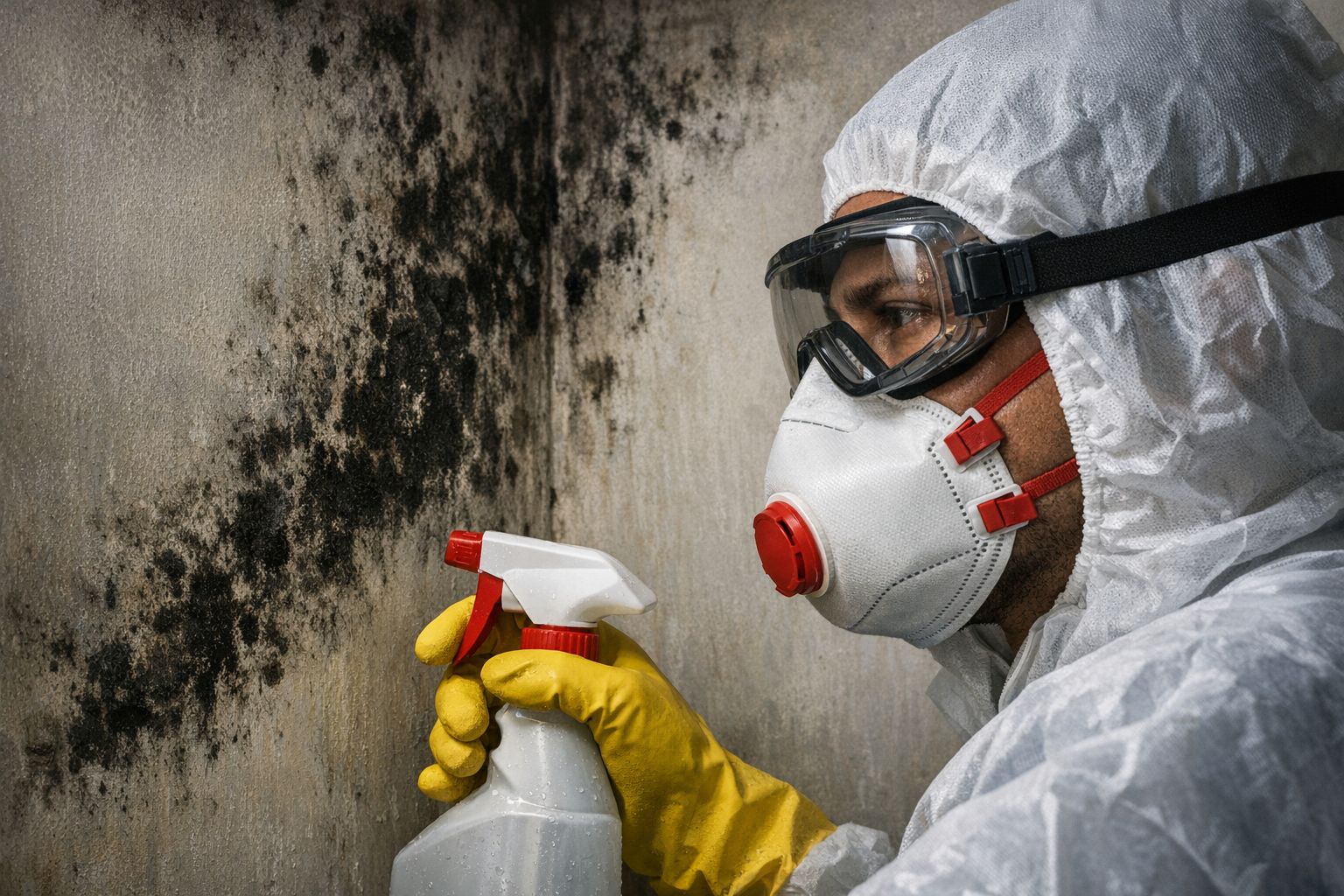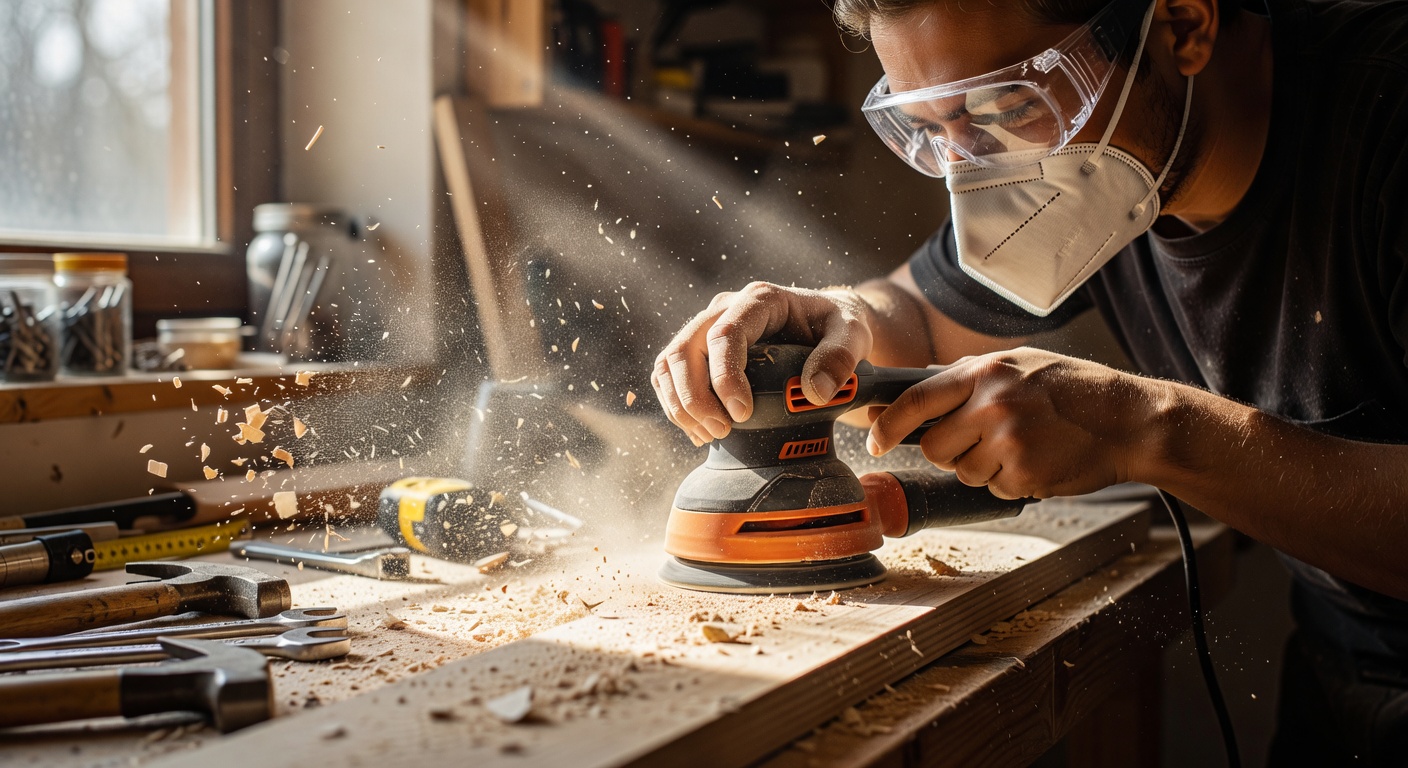
Spring's here, the weather's turning, and half the country is heading to the shed, the garage, or the spare room with a sander in hand. Whether you're skimming a wall, sanding floorboards, or cutting paving slabs, you need a mask. But which one?
Walk into Screwfix and you'll find a wall of options. Paper cups, fold-flats, half-masks with pink filters. The packaging is covered in codes like "FFP2 NR D" that mean nothing to most people. This guide cuts through the jargon and tells you exactly which mask to buy for your specific project, with live prices from UK suppliers.
Quick Reference: Which Mask Rating for Which Task
This is the table you'll keep coming back to. It tells you the minimum FFP rating for common DIY and trade tasks, based on HSE workplace exposure limits.
| Task | Minimum Rating | Why |
|---|---|---|
| Hand sanding softwood | FFP2 | WEL 5.0 mg/m³ — moderate dust levels |
| Power sanding softwood | FFP3 | Much higher dust concentration from orbital/belt sanders |
| Hand sanding hardwood | FFP3 | WEL 3.0 mg/m³ — hardwood dust is a Group 1 carcinogen |
| Sanding or cutting MDF | FFP3 (essential) | Double carcinogen: wood dust + formaldehyde (both IARC Group 1) |
| Plastering / skimming | FFP2 | Gypsum dust — irritant but not classified as carcinogenic |
| Sanding plaster / filler | FFP2 | Fine respirable dust, general WEL 4.0 mg/m³ |
| Cutting concrete or brick | FFP3 (essential) | Respirable crystalline silica — WEL 0.1 mg/m³, very hazardous |
| Drilling masonry | FFP2 (FFP3 preferred) | Lower dust volume than cutting, but silica still present |
| Mixing cement / morite | FFP2 | Alkaline dust, skin and lung irritant |
| Loft insulation work | FFP3 | Mineral wool fibres — irritant, difficult to filter at lower ratings |
| Paint stripping (heat gun) | FFP3 | Pre-1980s paint may contain lead. Assume it does. |
| Spray painting | A1P2 or A2P3 combo | Requires organic vapour + particulate filters — disposables won't do |
When in doubt, go one level up. FFP3 masks are only marginally more expensive than FFP2, and the protection difference is significant: 94% vs 99% filtration.
FFP Ratings Explained in 30 Seconds
FFP stands for Filtering Face Piece. There are three levels under the European EN 149 standard:
- FFP1 — 80% filtration, assigned protection factor (APF) of 4. Only suitable for nuisance dust. Not adequate for any task in the table above.
- FFP2 — 94% filtration, APF of 10. Handles most general construction dust, plastering, and softwood sanding. The most common rating for DIY work.
- FFP3 — 99% filtration, APF of 20. Required for hazardous dusts: hardwood, MDF, silica, lead, insulation fibres. If your task involves any carcinogenic material, this is the minimum.
The letters after the number also matter: NR means single-shift use only, R means reusable across shifts, and D means the filter passed a clogging test (better breathability when it gets loaded with dust).
The MDF Warning
MDF deserves its own section because it catches people out. It looks and handles like a benign material, but it's one of the most hazardous things you can sand in a home workshop.
MDF dust is classified as a double carcinogen. The wood dust itself is IARC Group 1 (proven human carcinogen), and the formaldehyde-based resin binder is independently IARC Group 1. When you sand MDF, you release both simultaneously.
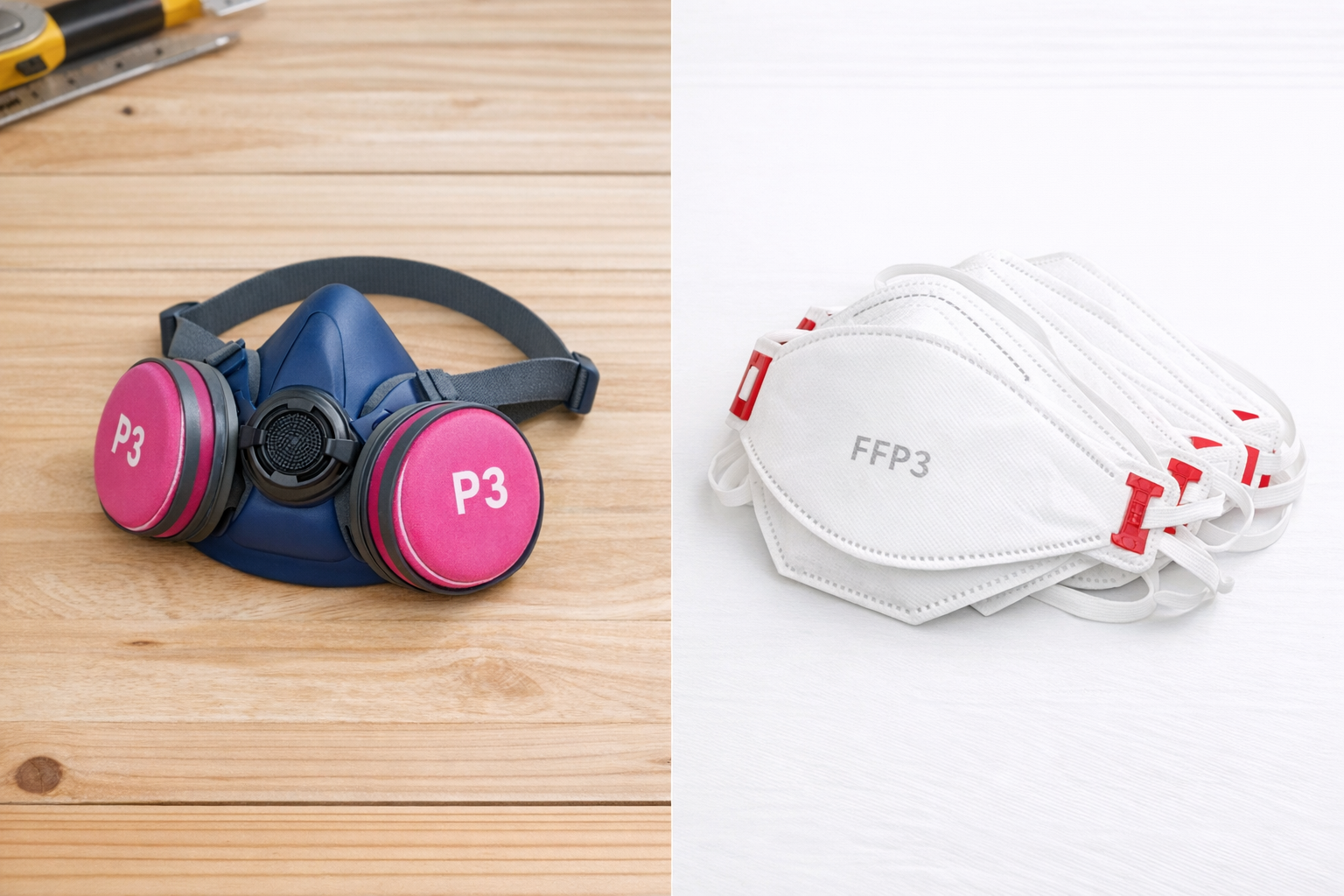
FFP3 is non-negotiable for MDF. An FFP2 mask is not sufficient. If you're doing a lot of MDF work, seriously consider a reusable half-mask with P3 filters — better seal, better protection, and far cheaper per use than disposables.
Best Disposable Masks for DIY
Best FFP2 for General DIY: 3M Aura 9320+
The 3M Aura 9320+ is the default recommendation for plastering, light sanding, cement mixing, and general construction dust. The three-panel fold-flat design sits away from your mouth, making it easier to breathe and talk. The embossed top panel helps direct exhaled air downwards, which reduces glasses fogging — a genuine quality-of-life feature if you wear specs.
Price: From £1.38/unit (Best4Safety, 20-pack) across 14 UK suppliers. Compare all prices →
For hot weather or long sessions, the valved 3M Aura 9322+ adds a Cool Flow valve for easier breathing. From £1.85/unit (Best4Safety, 10-pack) across 12 suppliers.
Budget pick: The Oxyline XR 250 FFP2 comes in at just £1.00/unit from The Face Mask Store in 20-packs. Earloop design is less secure than headband, but fine for short tasks.
Best FFP3 for Power Sanding & MDF: 3M Aura 9332+
The 3M Aura 9332+ is the most popular FFP3 disposable in the UK, and for good reason. It's tracked by 19 suppliers on Mask Directory alone. FFP3 protection with the Cool Flow valve means you can wear it through a full day of sanding without overheating.
This is your go-to for power sanding (any wood type), MDF work, cutting concrete or brick, loft insulation, and sanding old painted surfaces.
Price: From £0.10/unit (Seton UK, 50-pack) across 19 suppliers. Bulk packs offer exceptional value — buying 50 at a time works out to a fraction of the cost of buying boxes of 10. Compare all prices →
Need unvalved FFP3 (for example, working near others or in enclosed spaces)? The 3M Aura 9330+ offers the same FFP3 protection without a valve, from £0.40/unit (The Face Mask Store, 20-pack) across 10 suppliers.
Alternative pick: The Honeywell SuperOne 3207 is a solid cup-style FFP3 from £3.00/unit (Toolstation, 10-pack). Some people prefer the rigid cup shape — it holds its form better in dusty conditions and is easier to put on and take off repeatedly.
Best Reusable Masks for Regular DIYers
If you're sanding more than occasionally, disposables start adding up. A reusable half-mask with P3 filters gives you better protection (tighter seal than a disposable), better comfort (proper face cradle, adjustable straps), and dramatically lower ongoing costs.
JSP Force 8 with P3 Filters
The JSP Force 8 is the UK's most popular reusable half-mask for a reason. The PressToCheck system lets you verify the seal is good before every use — just press the filters, breathe in, and if the mask collapses slightly to your face, the seal is working. No fit-test kit needed for routine checks.
Price: The mask with P3 filters starts from £1.49/unit (Seton UK, 14-pack bulk) or typically £10–28 for an individual mask + filter set, across 13 suppliers. Compare all prices →
Replacement JSP PressToCheck P3 filters cost from £3.94/pair (Start Safety) across 12 suppliers. A pair of filters typically lasts 1–4 weeks depending on dust levels, so ongoing costs are pennies per session.
GVS Elipse SPR501
The GVS Elipse SPR501 is the ultralight alternative. At around 130g it's barely noticeable, and the HESPA-grade P3 filters sit in compact disc-shaped housings that don't stick out as far as the JSP's. Popular with woodworkers who want something less bulky for workshop use.
Price: From £6.33/unit (Respirator Shop) or typically £27–30 individually, across 6 suppliers. Compare all prices →
Moldex 7002
The Moldex 7002 is a workhorse from a brand trusted across European industry. Bayonet-style filter connection, wide field of vision, and a speech diaphragm so you can communicate without removing the mask. Compatible with a wide range of Moldex filter types for different hazards.
Price: From £17.40 (The Safety Supply Company) for the mask body. Add P3 filters separately. Compare all prices →
Reusable Disposable? The Oxyline X 320
The Oxyline X 320 FFP3 sits between disposable and reusable. It's a fold-flat FFP3 rated for multiple shifts (R-rated, not single use). From £1.50/unit. Good option if you want something you can throw in a toolbox and reuse for a few days without the commitment of a full half-mask setup.
Replacement Filter Costs Compared
For reusable masks, the ongoing cost is all about the filters. Here's what you'll spend:
| Filter | Fits | From Price | Suppliers |
|---|---|---|---|
| JSP PressToCheck P3 Filters | JSP Force 8 | £3.94/pair | 12 |
| 3M 6035 P3 Filters | 3M 6000/7500 series | £1.49/unit | 9 |
| Stealth P3 Filters | Stealth half-masks | £1.99/unit | — |
P3 filters on a properly sealed half-mask give you the same 99.95% filtration as an FFP3 disposable, but with a much better face seal.
Glasses Fogging: How to Fix It
If you wear glasses, fogging is probably your number one complaint with dust masks. Warm exhaled air leaks upward past the nose bridge and fogs your lenses. Here's what actually works:
- Use a valved mask. The valve directs exhaled air downward through the valve opening rather than up past the nose. The 3M Aura 9332+ and 9322+ are particularly good here.
- The 3M Aura design helps. The embossed top panel on all Aura models channels air away from the nose bridge area. It's a small design detail that makes a real difference.
- Mould the nose clip properly. Press firmly along its entire length with both thumbs. A poor nose clip seal is the primary cause of fogging.
- Use a reusable half-mask. Half-masks like the JSP Force 8 seal far better around the nose area than any disposable, virtually eliminating fogging.
- Anti-fog sprays or wipes. Applied to your glasses, these provide a temporary hydrophilic coating. Works well alongside a valved mask.
Beards and Facial Hair: The Uncomfortable Truth
If you have a beard, stubble, or significant sideburns, no tight-fitting respirator will seal properly. This includes every disposable FFP2 and FFP3 mask, and every reusable half-mask or full-face mask listed in this guide.
This isn't a suggestion — it's physics. The HSE's guidance (INDG479) is clear: facial hair that passes between the face and the sealing surface of a respirator will cause leakage. Even a day's stubble can reduce protection significantly.
Your options if you have facial hair:
- Shave the seal area. You don't need to be clean-shaven everywhere — just where the mask seals against your face (chin, cheeks, upper lip).
- Use a powered air-purifying respirator (PAPR). Loose-fitting hoods or helmets with powered filtration don't rely on a face seal. They're expensive (typically £200+) but they're the only option that works with a full beard.
Disposable vs Reusable: The Maths
For a quick one-off job — skimming a single room, sanding a door — disposables make sense. For regular work, the economics shift quickly:
- 20 weekends of sanding (disposable): 20 × 3M Aura 9332+ at ~£2–4 each = £40–80
- 20 weekends of sanding (reusable): JSP Force 8 (~£20) + 5 pairs of P3 filters (~£20) = £40 total, with better protection
The reusable pays for itself within a couple of months and provides a better face seal throughout. If you're renovating a house, it's a no-brainer.
HSE Hierarchy of Controls: Masks Are the Last Resort
One thing worth mentioning: under UK health and safety law, RPE (respiratory protective equipment) should be the last line of defence, not the first. The HSE hierarchy of controls says you should:
- Eliminate the hazard (can you use a different, less dusty material?)
- Substitute (can you use pre-cut MDF instead of cutting on-site?)
- Engineering controls (dust extraction, wet cutting, on-tool extraction)
- Administrative controls (limit exposure time, ventilate the space)
- PPE (masks) — only when the above aren't sufficient
In practice for DIY, this means: use dust extraction where possible, work outdoors or with windows open, and use wet cutting methods for masonry. Then wear a mask on top of those measures. A mask alone in a sealed room full of MDF dust is better than nothing, but it's not best practice.
Our Recommendations by Project Type
| Project | Recommended Mask | From Price |
|---|---|---|
| Plastering / skimming walls | 3M Aura 9320+ (FFP2) | £1.38/unit |
| Sanding floors (softwood) | 3M Aura 9322+ (FFP2, valved) | £1.85/unit |
| Sanding MDF / hardwood | 3M Aura 9332+ (FFP3, valved) | £0.10/unit |
| Cutting paving / concrete | 3M Aura 9332+ (FFP3, valved) | £0.10/unit |
| Regular workshop use | JSP Force 8 + P3 filters | £10–28 (mask + filters) |
| Loft insulation | 3M Aura 9332+ (FFP3) | £0.10/unit |
| Stripping old paint | 3M Aura 9332+ (FFP3) | £0.10/unit |
| Spray painting | 3M 7502 + A2P3 filters | Mask from £17+ |
All prices from live UK supplier data. Browse all products for current pricing and availability.
Where to Buy
We compare prices across 30+ UK suppliers on every product page. For the masks recommended in this guide, you'll typically find the best bulk pricing from safety equipment specialists rather than general DIY stores. The trade-off is that many specialist suppliers have minimum order values or charge for shipping on small orders.
Buying a box of 20 disposables rather than a pack of 3 from a DIY store typically saves 40–60% per mask. If you're doing any amount of regular DIY work, bulk is always worth it.